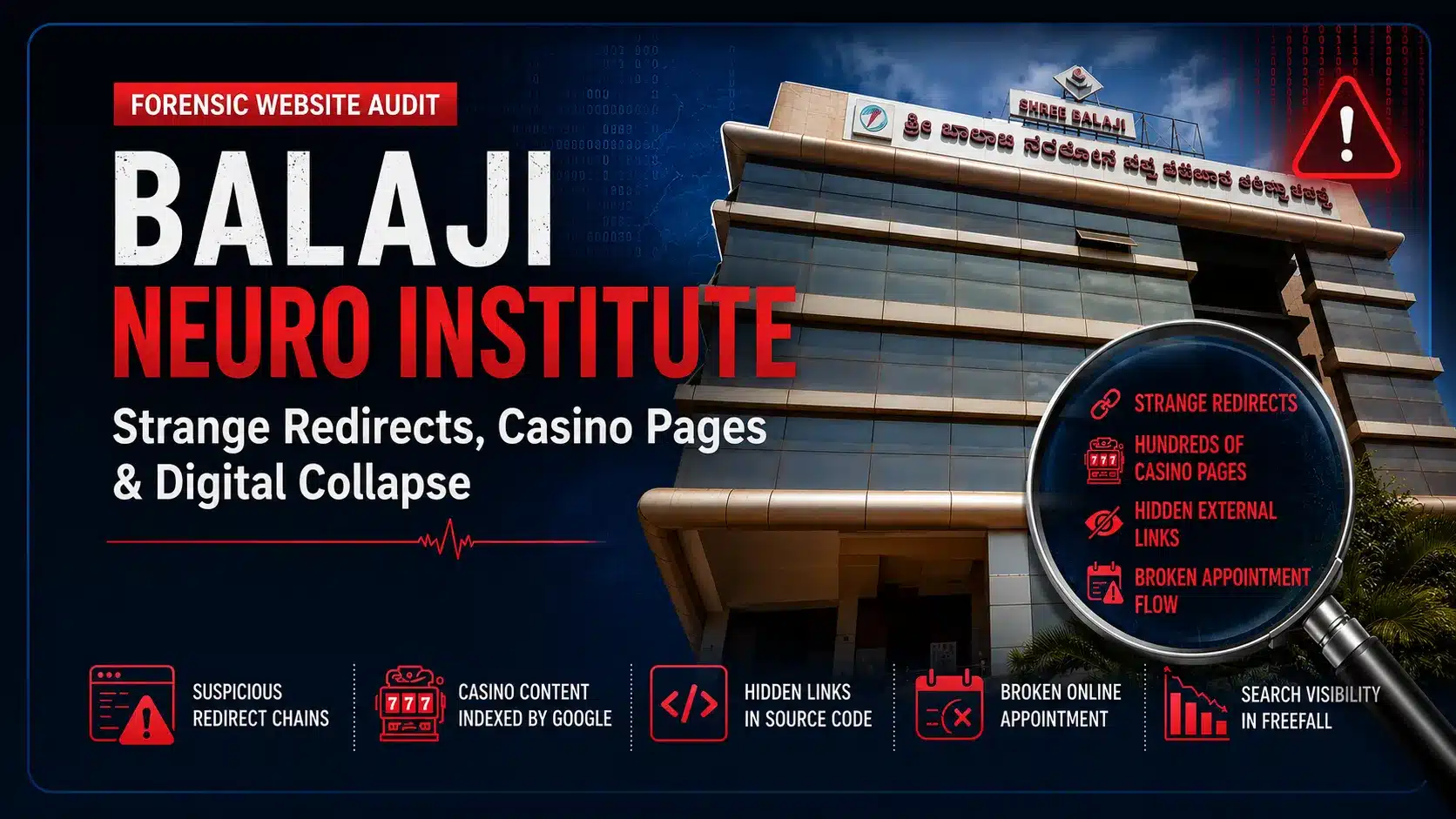
Balaji Neuro Hospital: Strange Redirects, Casino Pages & Digital Collapse
A forensic investigation into the digital history of a specialist hospital website — from incomplete architecture and unexplained redirects to hundreds of gambling pages, hidden external…
Author
Rohan
Published
1 Sept 2026
Updated
Updated 1 Sept 2026
Reading time
14 min read
In this article
A forensic investigation into the digital history of a specialist hospital website — from incomplete architecture and unexplained redirects to hundreds of gambling pages, hidden external links and a broken appointment flow.
Hundreds of gambling-related pages were publicly accessible and indexed
2026
A hidden external casino link was found inside the homepage source code
2026
The prominently displayed online appointment flow was broken
Individually, some of these problems could be explained as poor maintenance.
Together, they tell a much more concerning story.
1. The Early Website: A Digital Presence That Wasn’t Fully Built
The earliest version of the website appears to date back to around 2013.
At first glance, it looked like a conventional hospital website.
There was branding.
There were sections.
There were menus and links.
But an examination of the underlying structure revealed that much of the website was still incomplete.
Many links pointed to placeholder destinations or unfinished sections.
The website had the appearance of a developed digital presence without the depth of information architecture expected from a specialist hospital.
Several important areas existed structurally, but the content behind them was limited or unfinished.
The website remained broadly similar until a major redesign several years later.
The early version of Balaji Neuro Institute’s website showed an incomplete information architecture with numerous placeholder or unfinished sections.
A Website Can Look Complete Without Actually Being Complete
This is an important distinction.
A website does not become useful simply because it has:
a homepage
a logo
navigation
photographs
and a list of services
The real test is whether the underlying information architecture allows a visitor to meaningfully understand the organisation.
For a hospital, that means patients should be able to easily find information about:
departments
doctors
treatments
facilities
location
contact options
appointments
and other important services
The early version of this website appears to have been more of a digital brochure than a fully developed patient-facing platform.
2. 2018: A Major Redesign Changed the Website Architecture
Around mid-to-late 2018, the website underwent a substantial redesign.
The new version introduced a significantly more structured website.
The architecture now included sections for:
departments
facilities
consultants and staff
resources
education
gallery
careers
and online appointments
The site had also transitioned into a more sophisticated CMS-driven environment.
Visually and structurally, this was a major step forward from the earlier website.
The redesigned 2018 version introduced a more structured hospital website architecture.
However, redesigning a website is not the same as establishing long-term technical health.
And the years that followed began showing signs that the website was not experiencing consistent, stable maintenance.
3. A Period of Website Instability
Historical checks between 2018 and 2021 encountered repeated HTTP 403 responses.
A 403 response generally means that access to a requested resource has been forbidden.
The exact reason behind those historical errors cannot be determined from publicly available evidence alone.
Without access to:
server logs
hosting records
firewall configurations
WordPress security logs
or historical administrator activity
it would be irresponsible to claim a specific cause.
But the repeated instability itself is relevant.
A hospital website is not a disposable marketing asset.
It is part of the institution’s public infrastructure.
Long periods of unreliable access can affect:
patients
search engine crawling
search visibility
trust
enquiries
and the overall digital reputation of the institution
The instability was concerning.
But something even stranger appeared in 2021.
4. 2021: Important Hospital Pages Began Redirecting Elsewhere
This is where the investigation becomes significantly more unusual.
Historical evidence showed important pages on the primary domain unexpectedly redirecting visitors through unrelated external domains.
Examples included top-level URLs such as:
/about-us/
/deparments/
Instead of simply displaying hospital content, requests to these pages were observed returning HTTP 302 redirects.
The visitor was then sent through external domains unrelated to the hospital.
The Redirect Chain
One documented sequence followed this pattern:
Step
Destination
1
A page on balajineuroinstitute.com
2
HTTP 302 redirect
3
starbuck.xyz
4
Another HTTP 302 redirect
5
happy-winners-here.life
6
Redirect away from the hospital website
7
Final destination: Google Play listing for the Instagram application
This is important to interpret correctly.
The issue is not Instagram.
The issue is the unexpected redirect chain.
A visitor requesting an important page on a hospital website should not normally be routed through unrelated third-party domains before being taken somewhere else entirely.
Historical evidence showing a hospital website URL returning an HTTP 302 redirect and sending the request through an unrelated external domain.
Why This Matters
A broken link is one thing.
A normal redirect is another.
But unexpected multi-hop redirects involving unrelated third-party domains raise a completely different set of questions.
For example:
Who configured those redirects?
When were they introduced?
Were they intentional?
Were other pages affected?
Was the website compromised?
Were redirect rules inserted into the CMS, server configuration or database?
Did the problem affect search engines differently from ordinary users?
Publicly available evidence cannot answer all of those questions.
But it clearly establishes one thing:
Abnormal redirect behaviour was present years before the later casino-content problem became visible.
That historical context matters.
5. Important Department Pages Had Almost No Meaningful Content
The investigation also found another problem that may seem less dramatic but is extremely important for a hospital website.
Several major department pages contained very little meaningful information.
Examples included:
Cardiology
Orthopedics
Radiology
One of the department pages consisted of little more than a heading and a small number of bullet points.
An example of an important department page containing extremely limited information.
Why Thin Content Matters for a Specialist Hospital
Patients visit department pages because they want answers.
They may be trying to understand:
what conditions are treated
which specialists are available
what procedures are offered
what facilities are available
when to seek treatment
and how to contact the hospital
A department page with almost no meaningful information does not help the patient make an informed decision.
It also creates a weak foundation for search visibility.
A specialist hospital has enormous opportunities to create genuinely useful information around its expertise.
That opportunity appears to have been significantly underused.
6. The Website Also Showed Signs of Editorial Neglect
The career section provided another clue.
The page continued displaying job openings that appeared to date back to 2021.
By itself, an outdated career page is not a serious technical incident.
But it becomes relevant when viewed alongside everything else.
It suggests a broader pattern:
The website may not have been receiving consistent editorial and technical attention.
This distinction is important.
Websites rarely deteriorate because of one dramatic failure.
More often, they slowly accumulate problems.
A page is not updated.
A plugin is ignored.
A redirect is forgotten.
An old page remains indexed.
A security issue goes unnoticed.
A broken form stays broken.
Then, over time, the website becomes something nobody fully understands.
7. Then the Casino Content Started Appearing
From around 2024 onwards, something much more serious became visible.
The website began hosting content completely unrelated to healthcare.
Pages began appearing around topics such as:
online casinos
gambling
betting
casino bonuses
slot games
gambling platforms
sports betting
Some of the content appeared in multiple languages.
This was not a single accidental article.
It was a large-scale expansion of unrelated content inside a domain representing a specialist healthcare institution.
Gambling and casino-related articles found published within the Balaji Neuro Institute website.
This Is Not a Normal Content Problem
Publishing an outdated blog article is a content problem.
Having a broken page is a technical problem.
But hundreds of unrelated gambling pages appearing inside a hospital domain is something else entirely.
It raises serious questions about:
website integrity
content controls
administrator access
CMS security
publishing permissions
technical monitoring
and long-term website maintenance
The publicly visible evidence does not allow us to definitively identify how these pages entered the website.
But their presence is undeniable.
And their scale is difficult to ignore.
8. The Gambling Pages Were Not Hidden From Google
The situation became more serious when search results were examined.
The gambling-related pages were not simply unpublished files buried somewhere inside the website.
Many were publicly accessible.
And many were indexed by Google.
Search results showed pages from the hospital domain appearing with gambling-related titles in multiple languages.
Gambling-related pages from the Balaji Neuro Institute domain appearing in Google search results.
Hundreds of Unrelated URLs
The scale is one of the most disturbing aspects of the investigation.
The problem was not limited to:
five pages
ten pages
or a few accidental URLs
The gambling-related content existed in the hundreds.
The pages were:
hosted
publicly accessible
published
and indexed
For a healthcare domain, this represents a serious contamination of the website’s search footprint.
A search engine attempting to understand the purpose of a website should be seeing:
neurology
trauma care
doctors
treatments
medical facilities
patient information
Instead, the domain had accumulated large volumes of completely unrelated gambling content.
9. At the Same Time, Organic Visibility Collapsed
The appearance of unrelated gambling content coincided with a significant deterioration in the website’s organic search visibility from July 205 onward.
Historical performance data showed the website reaching substantially stronger visibility in earlier periods.
By August 2026, that visibility had fallen to its lowest observed level.
The number of ranking keywords had dropped dramatically.
Keyword Ranking Distribution — July 2025 Vs. August 2026
Ranking Position
June 2025
August 2026
Change
🟠 Top 3
5
1
-4
🔵 Positions 4–10
11
1
-10
🔵 Positions 11–20
26
2
-24
🔵 Positions 21–50
135
5
-130
🔵 Positions 51–100
87
0
-87
🟣 AI Overviews
0
Not shown
—
🟢 Other SERP Features
13
Not shown
—
Total Keywords
277
9
-268
Did the Casino Content Cause the Decline?
That cannot be stated as a proven fact based solely on correlation.
Search performance can decline for many reasons, including:
technical problems
content quality
indexing issues
algorithm changes
loss of important pages
weak authority
competitors
and website architecture problems
However, one thing is beyond reasonable dispute:
A healthcare website carrying hundreds of unrelated gambling pages represents a serious search-quality and website-integrity problem.
Regardless of whether it was the sole cause of the decline, it should never have been allowed to reach that scale.
10. Then We Looked Inside the Homepage Source Code
The investigation did not stop at visible pages.
The current homepage source code was also examined.
And another unusual finding appeared.
A link pointing to an external gambling website was found embedded inside the homepage HTML.
The link was not presented as normal visible content.
Instead, it appeared to be positioned far outside the visible area of the page.
An ordinary visitor would have little reason to encounter it.
But the link remained present inside the source code.
This is particularly important.
Because it suggests that the problem may not be limited to spam articles published on rogue URLs.
The primary homepage itself appears to contain unrelated external content.
Homepage source code showing an unrelated external gambling link positioned outside the visible page area.
Why This Finding Is Significant
A hospital website should have very clear reasons for every important external link it contains.
For example:
social media profiles
accreditation organisations
medical associations
partner institutions
government services
An unrelated gambling link does not belong in that list.
The fact that the link appears embedded in the homepage source code makes this a significantly more serious finding than simply discovering an unrelated article somewhere deep inside the website.
It raises an obvious question:
How did it get there?
That question deserves a proper technical investigation.
11. And One of the Most Important Patient Actions Was Broken
There was another problem.
While hundreds of unrelated pages were publicly accessible on the website, one of the website’s most important functions was not working properly.
The Online Appointment button is prominently displayed in the website header.
A visitor would reasonably assume that clicking it would allow them to book an appointment.
Instead, the page returned an error.
The prominently displayed Online Appointment button returned an XML parsing error instead of a functioning appointment interface.
This Is More Than a Broken Link
For a hospital, an appointment function is part of the conversion path.
A potential patient may:
Find the hospital through Google.
Visit the website.
Review the services.
Decide to seek treatment.
Click the appointment button.
And then encounter an error.
That is not merely a technical inconvenience.
It is a potentially broken patient acquisition path.
And the contrast is difficult to ignore:
Hundreds of unrelated gambling pages were successfully published and indexed while a critical patient-facing function was broken.
That single contrast says a great deal about where the website’s maintenance priorities appear to have gone wrong.
The Bigger Pattern
No single issue should be examined in isolation.
A thin department page does not prove a security problem.
An outdated career page does not prove website compromise.
A redirect through an external domain does not automatically reveal who created it.
A casino article does not, by itself, explain how hundreds of pages appeared.
But when the evidence is placed on a timeline, the pattern becomes difficult to dismiss.
The Digital History of Balaji Neuro Institute’s Website
Year / Period
Observation
2013
Website launched with incomplete information architecture and numerous unfinished links
2018
Major redesign introduced a more structured website
2018–2021
Repeated instability and HTTP 403 access problems
2021
Important pages unexpectedly redirected through unrelated external domains
2021 onwards
Major department pages remained extremely thin
2021 onwards
Outdated career information remained publicly visible